

Tropical Storm Bavi is intensifying over the warm Pacific waters east of Guam on Thursday and appears poised to rapidly intensify into a dangerous Category 4 or Category 5 super typhoon that will affect the U.S. Northern Mariana Islands and Guam on Sunday. Late next week, Bavi may bring additional severe impacts to Asia.
As we move deeper into the most active months of the long 2026 Western Pacific typhoon season, the fourth typhoon of the year is brewing just west of Guam. So far this year, there have been seven tropical cyclones in the Western Pacific, with three making landfall and causing more than a dozen fatalities. One of those storms, Super Typhoon Sinlaku, made landfall in the Northern Mariana Islands as a powerful Category 4-equivalent typhoon. In fact, Typhoon Sinlaku remains the strongest tropical cyclone to make landfall anywhere in the world so far in 2026.
The Joint Typhoon Warning Center (JTWC), based in Hawaii, released an advisory Thursday morning on Tropical Storm Bavi (09W). Bavi is expected not only to become a typhoon within the next 24 hours, but also to reach super typhoon status before approaching Guam and the Northern Mariana Islands sometime Sunday afternoon or evening. The past few advisories have shifted the timing slightly earlier (and a bit more south), now showing Bavi moving through the islands sooner than previously forecast.

Bavi’s track guided by the subtropical ridge, intensity fueled by warm waters
Forecasters indicate that Bavi will continue moving west-northwest through Thursday, steered by the subtropical ridge located to its northeast. Satellite imagery shows that the tropical cyclone has become better vertically aligned over the past six hours, with improved outflow as well. Although the low-level circulation remains somewhat ill-defined in the latest imagery, Bavi is expected to become better organized soon. By Friday, forecasts indicate Bavi should already have maximum sustained winds of 105 mph (165 km/h) while continuing to move generally westward. Sea surface temperatures across the region remain extremely warm, ranging from 29 to 30°C (84–86°F), with high ocean heat content. Combined with light to moderate vertical wind shear (5-15 knots), through Friday, these conditions will support rapid intensification.
As we move into the weekend, Bavi is expected to continue tracking west-northwest while steadily strengthening, likely reaching super typhoon status (150 mph winds) by Sunday morning, July 5. The latest forecast takes Bavi south of Saipan in the Northern Mariana Islands. However, even a slight shift farther south could bring the storm closer to Guam, increasing the threat of damaging winds, torrential rainfall, and rough surf. Rainfall could reach 4 to 5 inches within one hour, which will likely cause flash flooding.

According to the Thursday morning JTWC forecast, Bavi’s projected track closely resembles that of Super Typhoon Sinlaku in mid-April. One key difference is that Bavi is expected to continue moving west-northwest after passing the Northern Mariana Islands, allowing the core of the storm to not linger over the islands. In contrast, Super Typhoon Sinlaku turned northward, causing heavy rain and thunderstorms to linger over the islands for a longer period. By maintaining its west-northwestward track, Bavi will remain over very warm waters across the western Pacific. Current forecasts indicate the cyclone should remain a super typhoon with maximum sustained winds of 155 mph (250 km/h) into the beginning of next week. Next week, we will be closely monitoring where it could head next in Asia.
Residents of Guam and the Northern Mariana Islands should complete storm preparations by Sunday morning, as winds are expected to increase rapidly and conditions will deteriorate quickly. Tropical storm or typhoon watches will likely be issued for much of the Mariana Islands as early as Friday, followed by warnings as Bavi approaches.
The Japan Meteorological Agency, the official agency responsible for typhoon warnings in the Northwest Pacific, estimated at 11 a.m. EDT Thursday that Bavi’s central pressure was 992 mb, with sustained 60 mph (95 km/h) winds (10-minute average, which is normally substantially lower than the 1-minute average used by the Joint Typhoon Warning Center). Bavi’s name was contributed by Vietnam and refers to the Ba Vì mountain range in Vietnamese.
The U.S. Northern Mariana Islands is a U.S. commonwealth, separate from the U.S. territory of Guam. Close to two-thirds of the Northern Mariana Islands’ residents are U.S. citizens. According to the 2020 census, the populations of the three main islands were:
Saipan: 43,385
Tinian: 2,044
Rota: 1,893

Bavi expected to be the 2nd significant typhoon of 2026 for the Northern Mariana Islands
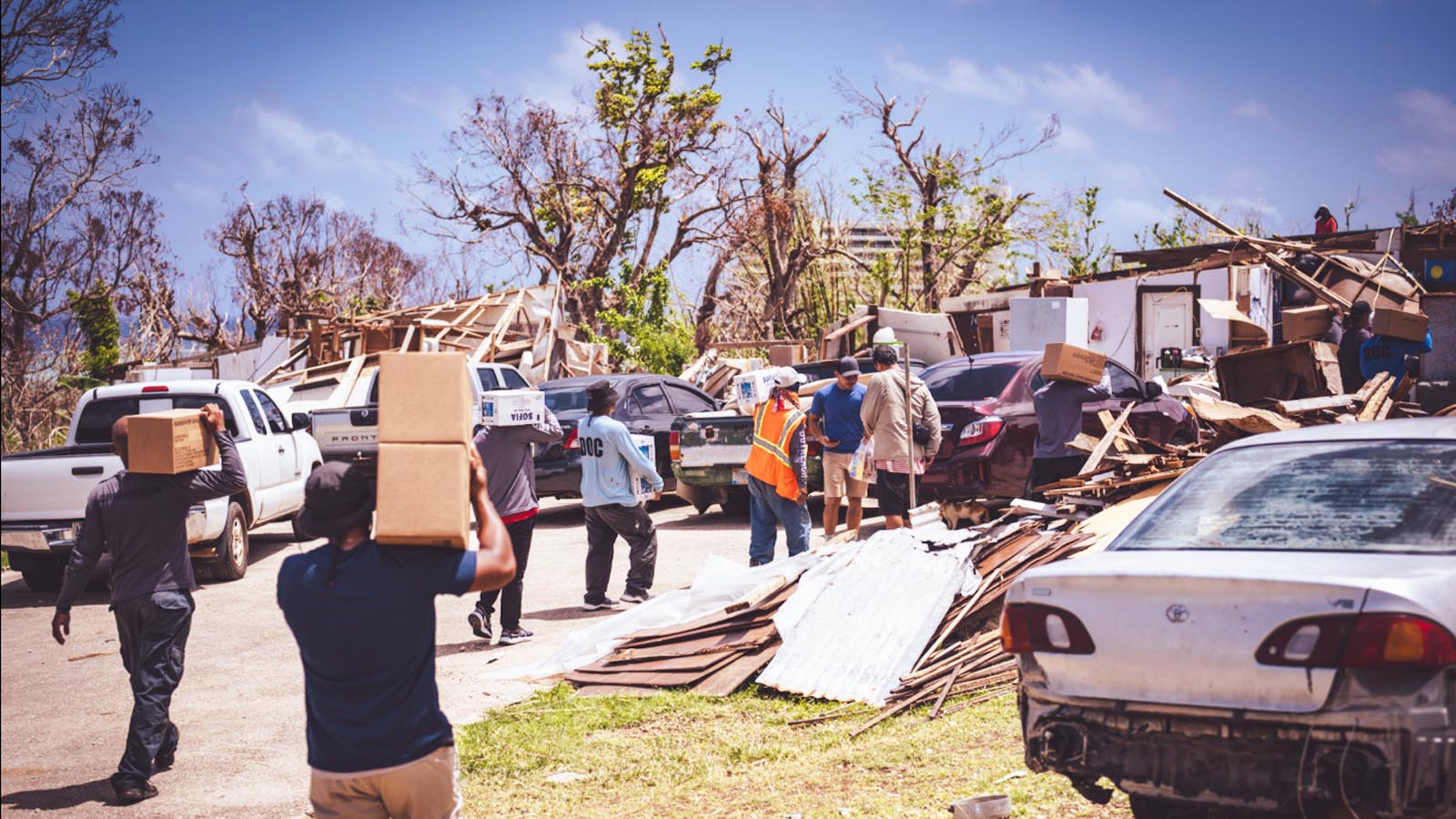
The Northern Mariana Islands are still recovering from extreme damage inflicted by Typhoon Sinlaku in April. Sinlaku peaked as a Cat 5 with 185 mph (295 km/hr) winds on April 12 southeast of Guam. As it approached the Northern Mariana Islands, an eyewall replacement cycle weakened the storm. Sinlaku made landfall over the U.S. Northern Mariana Islands on April 14, with the large eye of the storm passing over both Tinian and Saipan islands simultaneously. According to the Joint Typhoon Warning Center (JTWC), Bavi was a Category 4 with sustained winds of 145 mph (230 km/hr) at landfall. Sinkalu was moving very slowly at landfall, subjecting the islands to an extended battering. Total damage to the Northern Mariana Islands and Guam was estimated at about $1.5 billion. The typhoon was blamed for six deaths in the islands when a cargo vessel capsized in the storm near Pagan Island.

An unprecedented battering by Cat 4s and Cat 5s for the U.S.
Sinlaku was the 10th Category 4 or 5 tropical cyclone to hit a U.S. state or territory in the past 10 years — as many Cat 4 and Cat 5 landfalls as the U.S. suffered in the prior 57 years. The Northern Marianas were also battered by a Cat 5 typhoon in 2018, Typhoon Yutu, which did over $1 billion in damage.
Beginning in 2017, the U.S. has gotten absolutely hammered by high-intensity Category 4 and 5 hurricanes: Seven have hit the continental U.S., one has hit Puerto Rico, and two have hit the Northern Mariana Islands — with a potential third one to come on Sunday That’s as many U.S. Cat 4 and Cat 5 landfalls as had occurred in the prior 57 years (Fig. 1). Jeff Masters did an in-depth analysis of why this might be happening — it’s a combination of natural variability and climate change — in a previous post this year, “Will climate change bring more major hurricane landfalls to the U.S.?“

Bob Henson contributed to this post.

Source link