

People who are still thawing out from the Midwest to the mid-Atlantic may be wondering: How bad a winter was this for the nation as a whole? The answer: very bad – if you’re concerned about long-term warming and intensified drought impacts, that is.
Winter 2025-26 (December through February) was the second-warmest in U.S. records going back to 1895. The average temperature for the contiguous states was 37.13 degrees Fahrenheit, according to the monthly roundup released on March 9 by NOAA’s Climate Prediction Center. Given that the warmest winter on record was 2023-24, with 37.47 degrees F, the two warmest U.S. winters in 131 years of data have now occurred in the last three years.
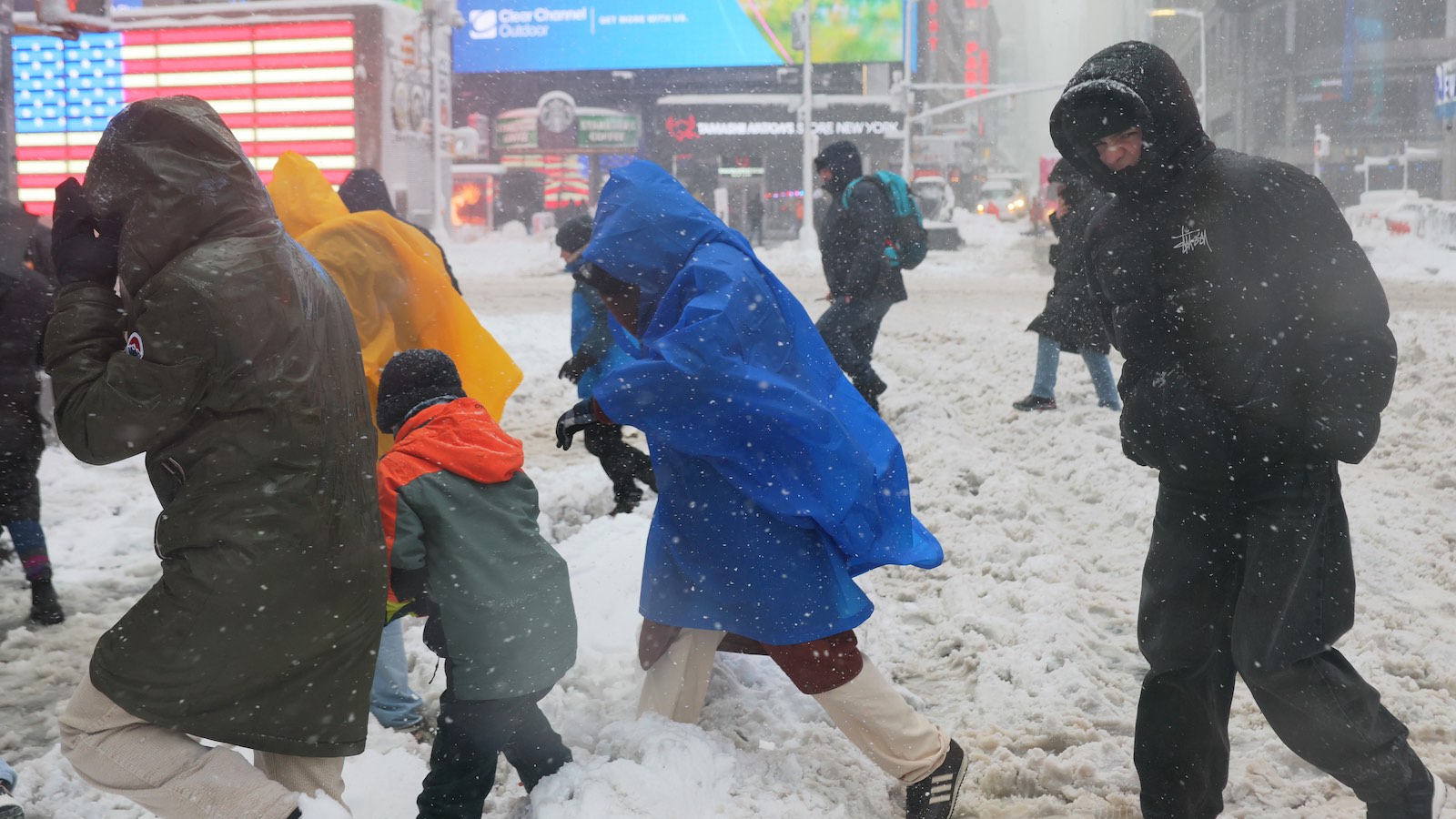
It’s true that many parts of the northeastern half of the country, roughly from the Great Lakes into the Eastern Seaboard and Deep South, saw stretches of cold and snow that rivaled anything over the last few decades of local experience. Yet as a whole, it wasn’t a record-breaking winter at all – except for large stretches of the nation from the Great Plains westward, where many states and communities saw their warmest winter-long averages in more than a century of record-keeping.

Nine large Western states had their warmest winters on record: Arizona, Idaho, Nevada, New Mexico, Oklahoma, Oregon, Texas, Utah, and Wyoming. A total of 16 states had top-10 warmest winters, including every state from Texas to South Dakota westward to the Pacific coast. Meanwhile, a few of the nation’s more populous states, from Ohio to Massachusetts, had substantially colder-than-average winters. Across these states, though, roughly 25 to 45 winters since 1895 have each been colder than this past one.
Hot cities
Among the cities where residents enjoyed (or endured) their warmest winters on record – in some cases by phenomenal margins – are the following, shown with periods of record, or POR.
- Phoenix, Arizona: 64.0°F (old record 61.3 in 2024-25; POR 1895-)
- Las Vegas, Nevada: 55.3°F (old record 54.6 in 2014-15; POR 1937-)
- Albuquerque, New Mexico: 46.0°F (old record 43.1 in 1994-95; POR 1891-)
- Salt Lake City, Utah: 40.7°F (old record 38.5 in 2014-15; POR 1874-)
Driest U.S. winter in close to a half-century
Winter 2024-25 was the fifth-driest on record for the contiguous U.S., with a nationally averaged total of 4.17 inches of moisture (rain plus melted snow). The only drier winters on the books are 1976-77, 1930-31, 1980-81, and 1962-63. Notably, this winter was substantially warmer than those, so we can expect that the well-documented effects of warmer air on exacerbating drought impacts are playing out already.
An impressively large and varied set of 19 states, extending from Texas to Maine, experienced a top-10-driest winter. Only Michigan was substantially wetter than average for the winter as a whole.

As of March 3, the U.S. Drought Monitor showed moderate to exceptional drought covering 54.9% of the contiguous U.S., the greatest extent in more than two years and up from around 40% since the start of the year. La Niña winters, as we’re experiencing now, tend to be dry across the southern tier of the nation; however, in this case, drought also extends across many other parts of the nation.
The picture could change notably as 2026 unfolds. There are increasingly strong signals in both models and observations that El Niño conditions will displace La Niña later this year – perhaps starting as soon as this summer, as suggested in the monthly probabilities issued by NOAA’s Climate Prediction Center on March 9.

Some moisture managed to break through into California in February, giving the Los Angeles area a soggy break from the ominous dryness. The Sierra Nevada got hammered with widespread three- to six-foot snow totals, triggering an avalanche that killed nine people, the deadliest in modern state history. Since then, balmy temperatures have been melting the Sierra snowpack at an unusually fast clip. That’s been recharging reservoirs, but it’s also fast depleting the mountainside storehouses of snow that are crucial for ecosystem health and wildfire protection.
Two freaky fortnights and a string of late–winter storms
Two noteworthy two-week periods this winter stretched across parts of two calendar months. That timing diluted their impact on monthly averages, but each one still led to some eye-opening weather.
Across the two weeks surrounding the year-end holidays – from Saturday, December 20, through Sunday, January 4 – large parts of the central and western U.S. saw absurdly tranquil weather, giving many locations their warmest-ever averages for that time frame.

Just a month later, the meteorological tables were turned as a surprisingly brutal spell of cold and widespread ice and snow gripped much of the nation east of the Rockies.
As different as they were, both these episodes fit within the broad-scale pattern of the whole winter: colder to the North and East, warmer to the South and West, and warmer than average for the country as a whole.
Cold spell
From Tuesday, January 20, through Wednesday, February 4, the averages in many cities east of the Mississippi were the coldest they’ve seen in decades for that midwinter period.
- Cleveland, Ohio: 11.8 degrees F (coldest since 1963; third-coldest on record; POR 1871–)
- Detroit, Michigan: 12 (coldest since 1963; fourth-coldest on record; POR 1874-)
- Louisville, Kentucky: 20.7 (coldest since 1985; 9th-coldest on record; POR 1873-)
New York, New York (Central Park): 22 (coldest since 1961; 8th-coldest on record; POR 1869-) - Washington, D.C.: 25.7 (coldest since 1961; 9th-coldest on record; POR 1872-)
- Nashville, Tennessee: 26.5 (coldest since 1978; 11th-coldest on record; POR 1875-)
The initial cold blast of late January was accompanied by the highest-impact storm of the winter, a nasty blend of snow, sleet, and freezing rain that affected tens of millions of people on January 24-26 from eastern Texas to New England. Nashville, Tennessee, endured its most widespread ice-related power outages on record, and northern Mississippi was also hard hit by freezing rain; in these two areas alone, some 700,000 people lost power, many for the better part of a week. Insured losses from the storm nationwide were estimated at $4-7 billion by Fitch Ratings; the death toll (direct plus indirect deaths) was 167, according to usdeadlyevents.com.

From the Carolinas to the Northeast, the snowfall kicked off a month-long period of unusually sustained chill. Mountains of plowed snow sat on roadsides for weeks on end along the Interstate 95 corridor. At both Washington and Philadelphia, temperatures failed to top 32 degrees F from January 24 through February 1. That nine-day stretch was the longest period at or below freezing for both cities in 47 years.
An intense upper-level trough, part of a dramatic polar-vortex “stretch” from the Arctic to the eastern U.S., got recharged several times after the initial late-January winter storm. The result was more nor’easters that pulled Atlantic moisture on top of cold air trapped in place between the Appalachians and the East Coast. At the start of February, eastern North Carolina was pummeled by heavy snow and blizzard conditions extending all the way to the beaches of the Outer Banks. Widespread totals of 12 to 19 inches were accompanied by shrieking gales of 45 to 65 mph. Several weeks later, on February 22-24, a classic coastal storm centered well offshore dumped its heaviest snows and spun up blizzard conditions across parts of New Jersey, Long Island, and southeast New England. A preliminary all-time local and state storm-total record of 37.9 inches was recorded at Providence, Rhode Island.* Just to the east on Cape Cod, winds gusted to 98 mph at Wellfleet, Massachusetts. The snowfall total of 29.1 inches in Islip, New York, was that city’s largest two-day amount in records going back to 1963, and another 2.1 inches fell a couple of days later.
*A note for climatology and procedure geeks: Some of the automated rain gauges now used at official airport observing sites tend to underestimate the moisture content in winter snowfalls. On February 23, the Providence airport reported 35.5 inches of snow but just 1.67 inches of moisture. By comparison, Islip reported 2.63 inches of liquid with its 29.1 inches of snow, and in the notorious Blizzard of 1978 – Providence’s previous heaviest snow on record – the city recorded 3.2 inches of moisture and 28.6 inches of snow. Most nor’easters produce coastal snow ratios like these, not far from 10:1 snow to liquid, so the strange ratio of 21:1 reported from Providence with this latest storm suggests it’s worth watching to see if the numbers change once the preliminary data are reviewed.
Jeff Masters contributed to this post.

Source link