

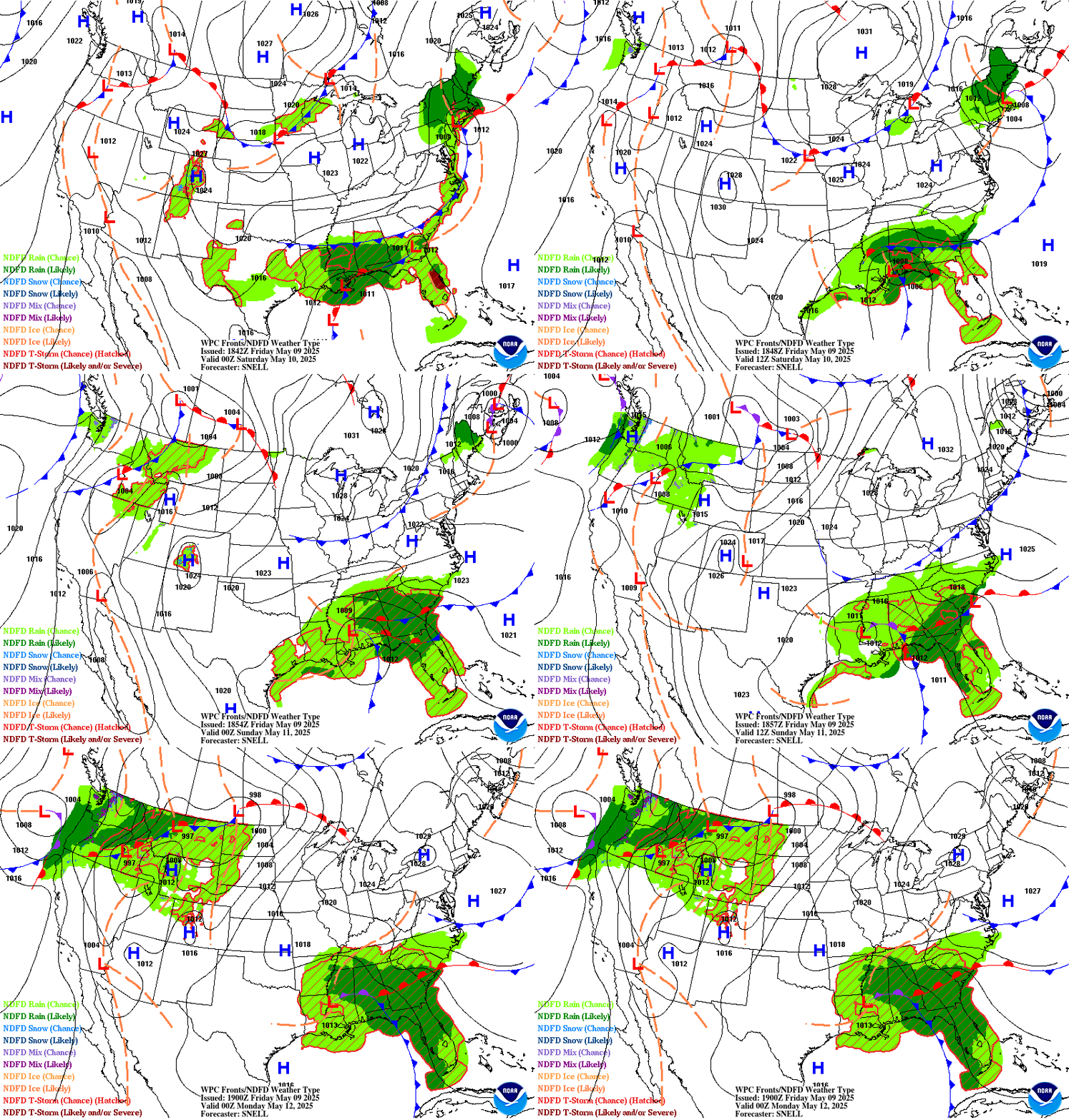
The forecasts depicted below combine WPC forecasts of fronts, isobars and high/low pressure centers with the NDFD depiction of expected weather type for days .5 to 2.5 ahead. Each frame represents 6 hours. A short range forecast discussion for the CONUS is available below the short term loop.
Short Term Forecast Frontal Systems and Isobars Loop
Short Range Forecast Discussion
FXUS01 KWBC 190624
PMDSPD

Short Range Forecast Discussion
NWS Weather Prediction Center College Park MD
214 AM EDT Sat Sep 19 2026

Valid 12Z Sat Sep 19 2026 - 12Z Mon Sep 21 2026

...Heavy Rainfall threat across portions of the Midwest, Ohio
Valley, Great Lakes, Central Plains into Northern Rockies through
Saturday...

...Heavy Rainfall threat expands into portions of the Mid-Atlantic
and Northeast on Sunday...

...Severe weather threat across portions of the central/southern
Plains and Rockies, Ohio Valley, and Southeast through the
weekend...

A progressive northern stream trough will move eastward from the
northern Plains into the Great Lakes toward the Northeast through
the weekend bringing chances for showers and thunderstorms across
the Upper Midwest into the Great Lakes, Ohio Valley, and
eventually the Northeast. The trough will push the surface frontal
boundary eastward and will drape across the Midwest into the
central/northern Plains and Rockies. The boundary will provide
sufficient forcing, while interacting with deep moisture and
instability, which will support periods of moderate to heavy rain
with locally excessive totals. The heaviest rainfall/flash
flooding concerns will be over portions of the Midwest, Great
Lakes, and Ohio Valley for Saturday, where the system is expected
to produce multiple rounds convection. Meanwhile, further west,
scattered thunderstorms may produce localized flash flooding over
the central/northern Plains into the Rockies through the weekend,
with a concentrated area for heavier rainfall rates over portions
of Montana for Saturday.

On Sunday, showers and thunderstorms will continue to slowly push
further east-northeast into the Ohio Valley and Mid-Atlantic and
portions of the Northeast. Continuous interaction with warm
moisture will reinforce excessive rainfall concerns over portions
of the Midwest and Ohio Valley/Great Lakes, while expanding the
risk into portions of the Northeast and Mid-Atlantic, where soil
remains saturated from previous rainfall. By late Sunday into
early Monday, the focus for heavier rainfall continues to shift
toward the coastal areas over the Northeast and Mid-Atlantic.
Additionally, Storm Prediction Center (SPC) has highlighted a risk
for severe thunderstorms capable of producing hail and severe
winds across portions of the central and southern Plains/Rockies,
Midwest, Ohio Valley, and Southeast through the weekend.

Across the Southeast, warm Gulf moisture will support scattered to
numerous showers and thunderstorms through the weekend. Slow
moving storms may produce high rainfall rates, which may lead to
isolated flash flooding over portions of the south Florida.
Additionally, residual anomalous moisture may lead to
thunderstorms over portions of Texas and southern Plains, which
pose a risk for localized heavy rainfall through the weekend.

Otherwise, above average temperatures will remain concentrated
across the southern Plains, mid to lower Mississippi Valley, and
the Southeast where persistent ridging will support highs in the
90s to lower 100s and warm overnight temperatures. Some locations
may approach or exceed daily records and Heat Advisories remain in
affect. Elsewhere, temperatures will trend closer to or below
normal behind the frontal boundary.


Oudit


Graphics available at
https://www.wpc.ncep.noaa.gov/basicwx/basicwx_ndfd.php


$$
Depicted Weather Types
- NDFD Rain (Chance) – There is chance of measurable rain (≥0.01″) at the valid time.
- NDFD Rain (Likely) – Measurable rain (≥0.01″) is likely at the valid time.
- NDFD Snow (Chance) – There is chance of measurable snowfall (≥0.01″ liquid equivalent) at the valid time.
- NDFD Snow (Likely) – Measurable snow (≥0.01″ liquid equivalent) is likely at the valid time.
- NDFD Mix (Chance) – There is a chance of measurable mixed precipitation (≥0.01″ liquid equivalent) at the valid time. “Mixed” can refer to precipitation where a combination of rain and snow, rain and sleet, or snow and sleet are forecast.
- NDFD Mix (Likely) – Measurable mixed precipitation (≥0.01″ liquid equivalent) is likely at the valid time. “Mixed” can refer to precipitation where a combination of rain and snow, rain and sleet, or snow and sleet are forecast.
- NDFD Ice (Chance) – There is a chance of measurable sleet and/or freezing rain (≥0.01″ liquid equivalent) at the valid time.
- NDFD Ice (Likely) – Measurable sleet and/or freezing rain (≥0.01″ liquid equivalent) is likely at the valid time.
- NDFD T-Storm (Chance) – There is a chance of thunderstorms at the valid time. Areas are displayed with diagonal hatching enclosed in a dark red border.
- NDFD T-Storm (Likely and/or Severe) – Thunderstorms are likely and/or the potential exists for some storms to reach severe levels at the valid time.